Can a Database Truly Be a Genius? – IBM’s Shift Toward Agentic Autonomy

Updated
Brad Shimmin, VP and Practice Lead at Futurum, explores IBM’s shift toward agentic autonomy. He analyzes how the new Db2 Genius Hub uses intent-driven reasoning to eliminate the “maintenance tax” for data professionals.
Futurum's Brad Shimmin,
Cite this
Brad Shimmin, The Futurum Group, "Can a Database Truly Be a Genius? – IBM’s Shift Toward Agentic Autonomy," March 10, 2026. https://trial.futurumgroup.com/press-release/can-a-database-truly-be-a-genius-ibms-shift-toward-agentic-autonomy/

Analyst(s): Brad Shimmin
Publication Date: March 10, 2026
IBM is reimagining its flagship database for the agentic era with the launch of the Db2 Genius Hub, moving beyond simple AI features toward an intelligent platform where agentic reasoning is the core experience. By prioritizing supervised autonomy and deterministic reasoning, IBM aims to alleviate the heavy operational burden on data professionals while maintaining critical human governance.
Key Points:
- The Db2 Genius Hub introduces an agentic-first management console that utilizes deterministic reasoning to proactively identify anomalies and provide specific remediation recipes.
- IBM’s strategy focuses on “Pragmatic Autonomy,” targeting human-led automation to act as a force multiplier for existing staff while maintaining transparency, observability, and governance.
- The new ecosystem includes a conversational AI assistant designed to integrate agentic intelligence directly into day-to-day workflows.
Overview:
For decades, the database market prioritized scale and speed, but the primary bottleneck has shifted to the cognitive load required to manage increasingly complex data estates. IBM’s launch of the Db2 Genius Hub marks a decisive inflection point, helping to move the broader market from “AI-washing” legacy infrastructure toward a future of agentic-native operations. This philosophy treats intelligence not as a “sidecar” chat interface, but as the fundamental way users interact with the data engine.
The core challenge facing the industry is the “maintenance tax”—the routine, non-differentiating toil that consumes the majority of a data professional’s week. IBM’s move toward intent-driven management addresses this reality directly. Rather than staring at dashboards and manually correlating logs, administrators can rely on agentic workflows to hunt for anomalies and deliver deterministic “recipes” for remediation.
The Burden of Data Maintenance
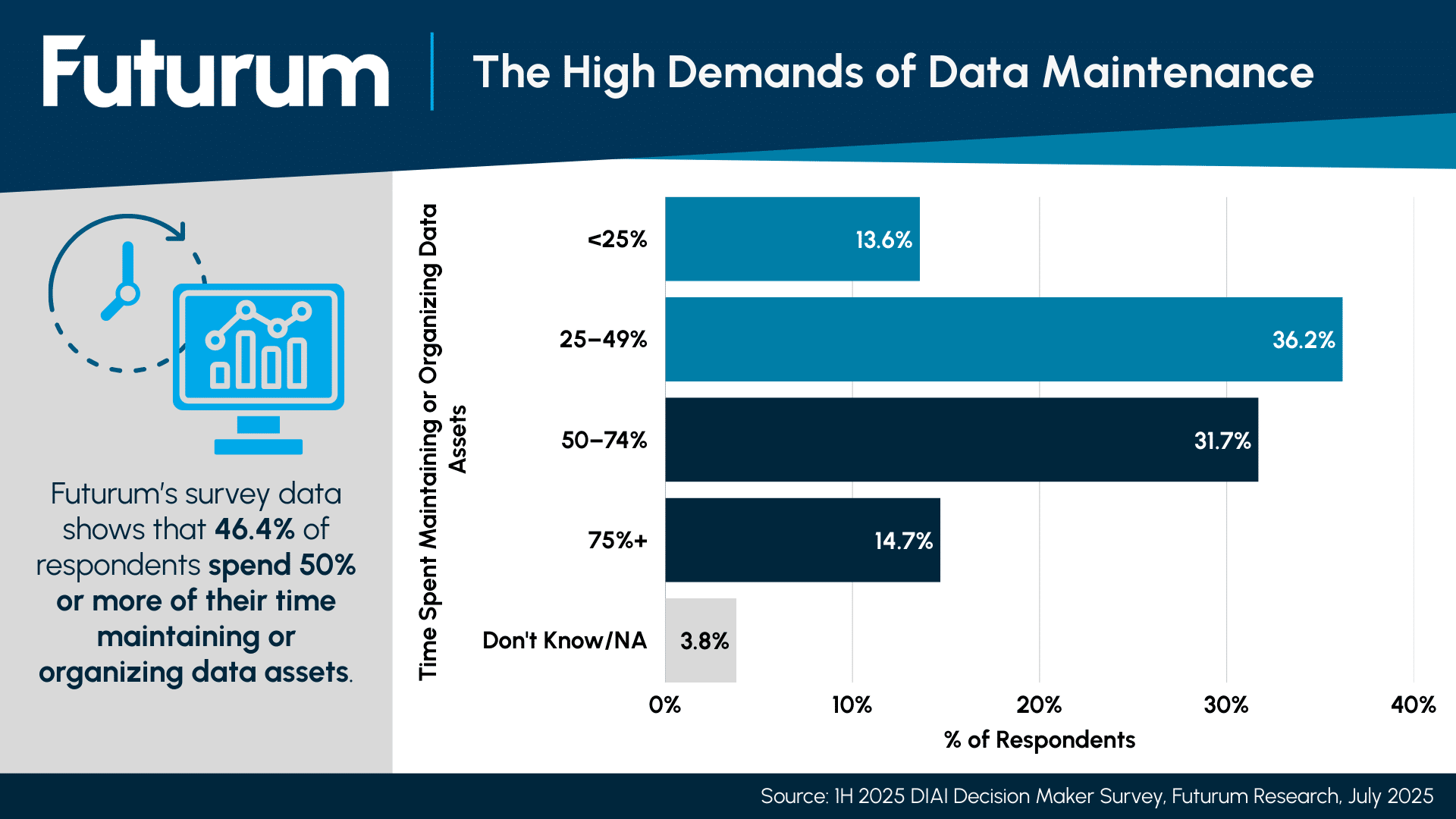
The need for this shift is underscored by current industry trends. According to Futurum’s 1H 2025 Data Intelligence, Analytics, and Infrastructure Decision Maker Survey, nearly half of all data professionals are bogged down by manual oversight (see Figure 1).
Figure 1: The High Demands of Data Maintenance
Pragmatic Autonomy and Deterministic Reasoning: IBM targets Level 2 and 3 supervised autonomy, acknowledging that enterprises do not want “driverless” systems that bypass human oversight. By focusing on deterministic reasoning—where the system can explain the “why” behind an issue and correlate specific telemetry—IBM ensures that AI-driven insights are auditable and trustworthy. This is a critical distinction from probabilistic models that may offer summaries but lack the precision to execute production-level fixes.
Expanding the Ecosystem: The launch includes a conversational AI assistant designed to integrate agentic intelligence directly into day-to-day workflows. This aims to bring text-to-SQL and agentic capabilities directly into the IDE, meeting developers where they already work.
Sovereignty in a Hybrid World: A vital differentiator for IBM is its support for these modern workflows across hybrid, on-premises, and air-gapped environments. This allows regulated industries, such as banking and healthcare, to adopt agentic autonomy without sacrificing the data sovereignty required by their compliance departments.
Conclusion
IBM’s shift to the “Genius” era represents a pragmatic approach to the AI-ready database. By focusing on unburdening the professional through supervised autonomy and deterministic workflows, IBM is moving the conversation from what a database can store to what it can actively manage. Success will depend on maintaining the hallucination-free reliability of these agents and fostering broad developer adoption of the Genius family of capabilities. As the “maintenance tax” continues to stifle innovation, the move toward agentic-native infrastructure is no longer a luxury—it is a competitive necessity.
The full report is available via subscription to Futurum Intelligence’s Data Intelligence, Analytics & Infrastructure IQ service—click here for inquiry and access.
See the official IBM Db2 Genius Hub announcement on the IBM website.
About the Futurum Data Intelligence, Analytics, & Infrastructure Practice
The Futurum Data Intelligence, Analytics, & Infrastructure Practice provides actionable, objective insights for market leaders and their teams so they can respond to emerging opportunities and innovate. Public access to our coverage can be seen here. Follow news and updates from the Futurum Practice on LinkedIn and X. Visit the Futurum Newsroom for more information and insights.
Published by Futurum.
More from Brad Shimmin
Elevate AI Agent Quality With Active, Intelligent Context
In its latest blueprint, Elevate AI Agent Quality with Active, Intelligent Context: How Informatica Plugin grounds Claude reasoning in trusted data, completed in partnership with Salesforce, Futurum Research examines why context blindness is the leading barrier to production-ready agentic AI, and…
Cloudera and Mistral AI Deliver Sovereign Private Intelligence
Brad Shimmin, VP and Practice Lead at Futurum, analyzes how Cloudera’s partnership with Mistral AI brings sovereign AI and local model fine-tuning to hybrid and air-gapped enterprise data estates.
Broadcom Builds Sovereign Agentic AI Foundations Around VMware Tanzu
Brad Shimmin, Vice President and Practice Lead at The Futurum Group, analyzes Broadcom’s VMware Tanzu Platform updates at VMware Explore 2026, covering deny-by-default agent runtimes, AI-ready data foundations, and TrueSource OSS security.