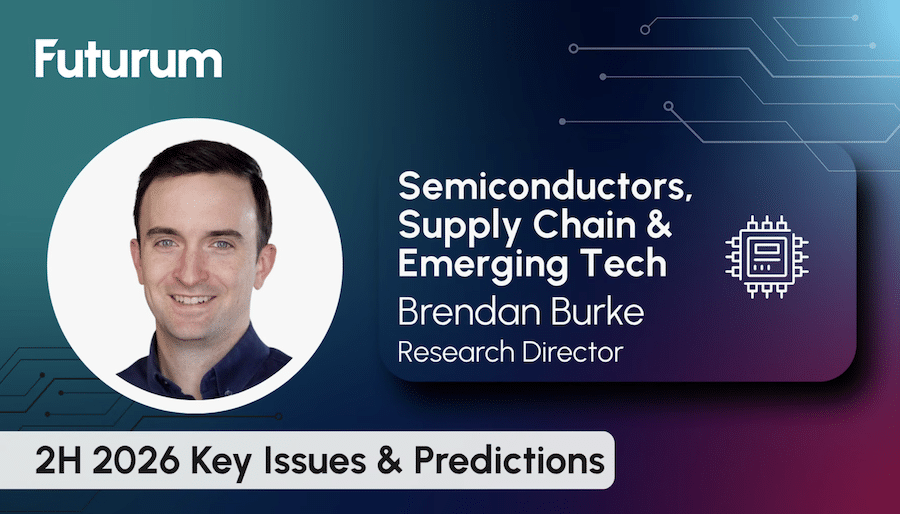
Brendan is Research Director, Semiconductors, Supply Chain, and Emerging Tech. He advises clients on strategic initiatives and leads the Futurum Semiconductors Practice. He is an experienced tech industry analyst who has guided tech leaders in identifying market opportunities spanning edge processors, generative AI applications, and hyperscale data centers.
Before joining Futurum, Brendan consulted with global AI leaders and served as a Senior Analyst in Emerging Technology Research at PitchBook. At PitchBook, he developed market intelligence tools for AI, highlighted by one of the industry’s most comprehensive AI semiconductor market landscapes encompassing both public and private companies. He has advised Fortune 100 tech giants, growth-stage innovators, global investors, and leading market research firms. Before PitchBook, he led research teams in tech investment banking and market research.
Brendan is based in Seattle, Washington. He has a Bachelor of Arts Degree from Amherst College.
Predictions
Friction at the Infrastructure Frontier Will Drive Token Prices Higher
In the back half of this year, the AI infrastructure market will collide with a structural paradox. While enterprise token demand has reached a multi-trillion-dollar utility scale, physical system integration barriers will temporarily break the historical trend of deflationary token pricing. The extreme complexity and structural immaturity of next-generation, liquid-cooled rack-scale architectures, combined with rigid enterprise capital constraints, will cause an intermediate re-rating of token prices higher as cutting-edge reasoning models debut before next-gen token factories can fully scale.
Why This Is Trending
Massive Token Production Outpaces Lab Projections: Enterprise token volume is no longer a forward-looking metric—it has matured into an active, heavy data center load. 54.7% of decision-makers plan to produce 51 trillion or more in tokens annually. To put this in perspective, when Meta disclosed a burn rate of roughly 60T tokens in a single month (~720T annualized), it was viewed as an outlier. Today, a significant portion of corporate IT buyers occupy that exact same bracket, transforming token generation into a core infrastructure utility bill.
Infrastructure Bottleneck & Capex Walls: Rising demand is colliding with physical and financial realities. 23.3% of infrastructure decision-makers now cite CapEx limits as their primary barrier to scaling AI compute. This is compounded by a severe deployment bottleneck, where 61.8% of leaders report token production lead times exceeding 4 months due to the complexity of liquid-cooled rack architectures. Simultaneously, an acute NAND flash shortage is inflating hardware bills of materials, driving up system integration costs, and squeezing deployment margins.
The Monolithic Pivot to NVIDIA Vera Rubin: Faced with CapEx limits, enterprises are consolidating around monolithic, co-designed architectures to maximize throughput. A definitive 74% of compute decision-makers plan to adopt NVIDIA’s Vera Rubin NVL72 platform for its unified networking fabric and promise of 35x token per megawatt gains.
Vendor Impact
Leveraging Custom Silicon for Token Price Relief: Deploying application-specific custom silicon allows infrastructure vendors to bypass the 2026 token price re-rating, transforming architectural optimization into an aggressive pricing weapon. Utilizing specialized internal silicon shifts the vendor competitive landscape away from a pure arms race of raw processing speed and into a targeted price-performance war, effectively stealing high-volume enterprise contracts from competitors tethered to premium commercial GPU margins.
Capacity Planning For Cooling and Networking: For infrastructure and capacity planners, the primary challenge is navigating a highly volatile hardware pipeline while preparing data centers for aggressive networking and cooling overhauls. With long hardware lead times and a storage shortage, planners must map out power allocation and liquid cooling retrofits long before hardware arrives. This friction is compounded by a near-universal cycle of networking switch upgrades, encouraging capacity teams to synchronize server arrivals with high-speed network availability to prevent next-generation clusters from sitting idle. Vendors that bring GPU-accelerated software simulation into data center design can stand out in system performance.
Early Adoption of Rack-scale Token Factories: Securing early system validation and shipment allocation pipelines for next-generation platforms—specifically NVIDIA’s Vera Rubin NVL72 and AMD’s open-standard Helios architecture—instantly positions a vendor as a tier 1 provider capable of commanding pricing premiums from enterprise buyers trapped in multi-month supply queues. By establishing early operational mastery over the complex systems, first movers entrench their primary multi-trillion token production factories within the specific hardware and software fabrics of these pioneer deployments.