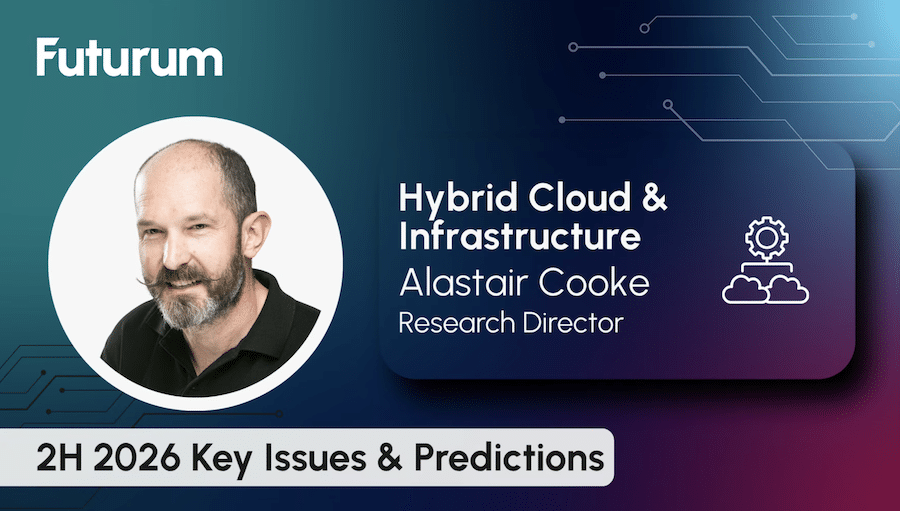
Alastair has made a twenty-year career out of helping people understand complex IT infrastructure and how to build solutions that fulfill business needs. Much of his career has included teaching official training courses for vendors, including HPE, VMware, and AWS.
Alastair has written hundreds of analyst articles and papers exploring products and topics around on-premises infrastructure and virtualization and getting the most out of public cloud and hybrid infrastructure. Alastair has also been involved in community-driven, practitioner-led education through the vBrownBag podcast and the vBrownBag TechTalks.
Predictions
Building New Mega-AI Datacenters will Stall as Supply-chain Issues Bite, Reducing Pressure on RAM and SSD Prices
By the start of 2027, many of the massive AI data center builds announced in late 2025 and early 2026 will be delayed or canceled. Several data center builds have already been blocked by communities and State governments; this trend will continue despite federal efforts to clear the blocks. A harder issue is the supply chain for essential components such as power transformers and optical fibers. High-power electrical transformers are needed between the power grid (or local power generation) and computers; supply is now back-ordered for years. Optical fiber faces another supply challenge, partly due to the war in Ukraine, which has consumed millions of miles of fiber for drones.
Why This Is Trending
The current high prices for, or unavailability of, RAM, SSDs, and HDDs are due to contracts to build massive AI data centers as quickly as possible. AI builders placed orders for hardware to fill their as-yet unbuilt data centers, leading to a predicted shortage and high prices for uncontracted production capacity.
The servers, GPUs, storage, and networks do not operate in isolation; they require a collection of infrastructure elements. Without chillers, transformers, and optical fiber connections, among many other essential components, the racks of servers won’t bring any income.
If the data center project cannot be guaranteed to operate profitably, or even service its construction debt, the project and its server orders will be canceled. The hype around the AI revolution will not forever hold back the pain of interest payments or shareholder returns.
Vendor Impact
Vendors with long-term supply contracts will continue to ride out the current high prices, insulated from them. The only risk is renegotiating contracts during periods of high prices; keeping the contracted term short will prove beneficial. Component pricing is unlikely to fall below pre-AI pricing, leaving existing contracts viable for these vendors.
Public Cloud vendors are likely to face the most headwinds, as their plans for massive AI expansion meet the realities of the supply chain. Many of the planned data centers are being built by or for these cloud providers. Difficulties and delays in delivering new data centers will lead to capacity constraints on existing services or difficulties delivering new ones.
For vendors exposed to current SSD and RAM prices, relief should come sooner than expected, long before new semiconductor fabs can be built, although not soon enough for some customers.