Skip to content
Let's talk
Mitch Ashley

Mitch Ashley is Vice President and Practice Lead, Software Lifecycle Engineering for The Futurum Group. Mitch has over 30+ years of experience as an entrepreneur, industry analyst, product development and IT leader, with expertise in software engineering, cybersecurity, DevOps, DevSecOps, cloud, and AI. Mitch comes to The Futurum Group through the acquisition of Techstrong Group (devops.com, securityboulevard.com, and techstrong.tv), where he serves as CTO and founder of Techstrong Research.

As a Chief Technology Advisor, CTO, CIO, and head of engineering, Mitch led the creation of award-winning cybersecurity products utilized in the private and public sectors, including the U.S. Department of Defense and all military branches. Mitch also led managed PKI services for broadband, Wi-Fi, IoT, energy management and 5G industries, product certification test labs, an online SaaS (93m transactions annually), the development of video-on-demand and Internet cable services, and a national broadband network. He began his career creating large banking and telecom applications and building AI expert systems.

Having led his first of three introductions of DevOps in 2014 and the modernization of three IT organizations, Mitch shares his experiences as an analyst, keynote and conference speaker, panelist, host, moderator, and expert interviewer. His talks cover some of the most in-demand topics, including CIO/CTO leadership, product and software development, DevOps, DevSecOps, containerization, container orchestration, AI/ML/GenAI, platform engineering, SRE, and cybersecurity. He publishes his research on futurumgroup.com/ and TechstrongResearch.com/resources. He hosts multiple award-winning video and podcast series, including DevOps Unbound, CISO Talk, and Techstrong Gang.


Predictions

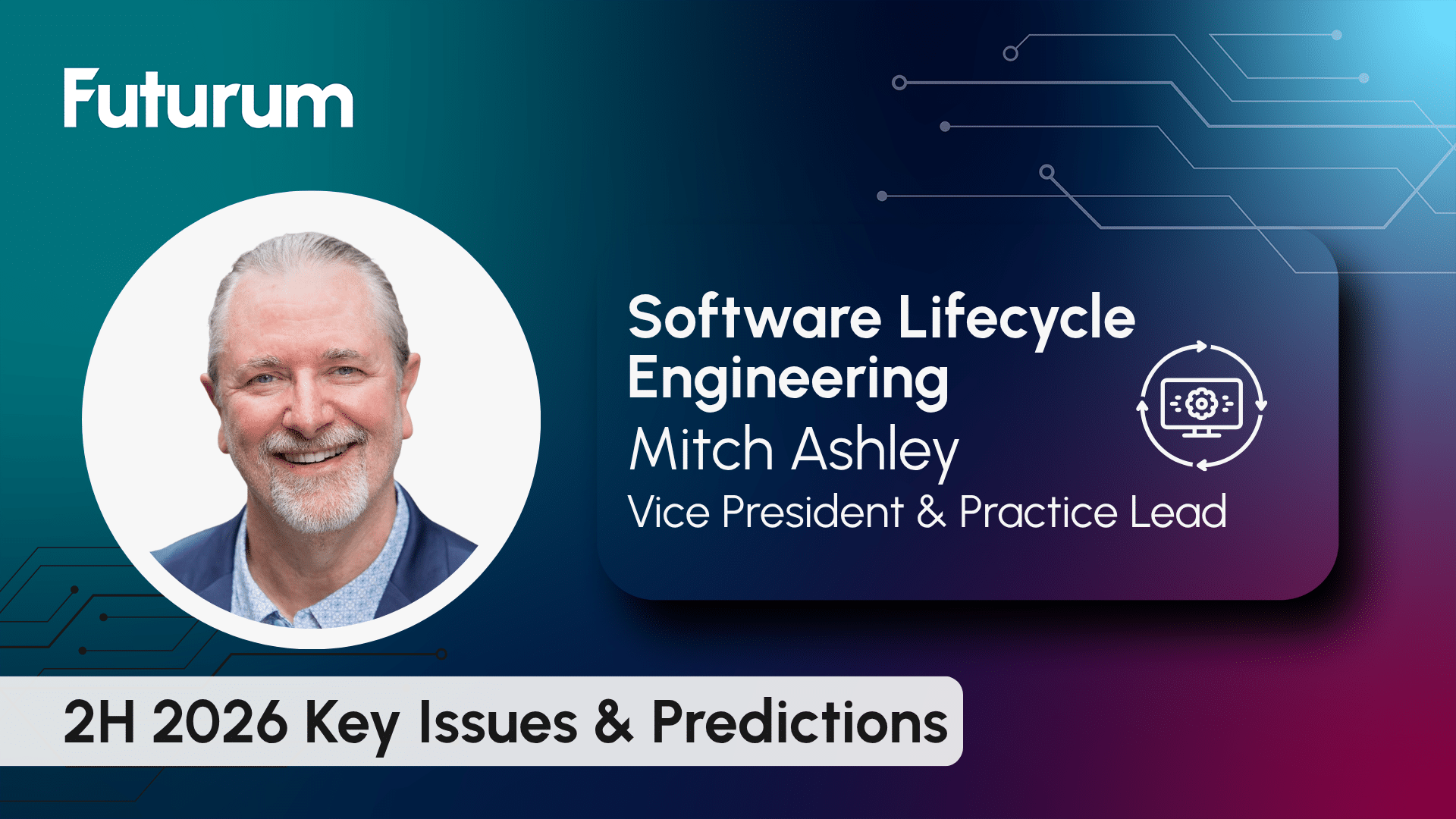
Software Lifecycle Engineering:
Interoperable Control Planes will Become the Primary Mechanism for Proving AI Outcomes, Prioritizing Open Standards Over Single-Stack Depth

By the end of 2026, the control plane will become the layer where enterprises prove AI outcomes, and for agent-driven work specifically, interoperability through open standards like MCP and A2A, across the models and tools a customer already runs, rather than depth in any single stack, decides which vendors own it. The deployment-to-value gap is already measurable: GitHub Copilot is deployed at 59% of organizations, yet the plurality of adopters have licensed it to no more than 20% of their developers¹.

Watch on Vimeo

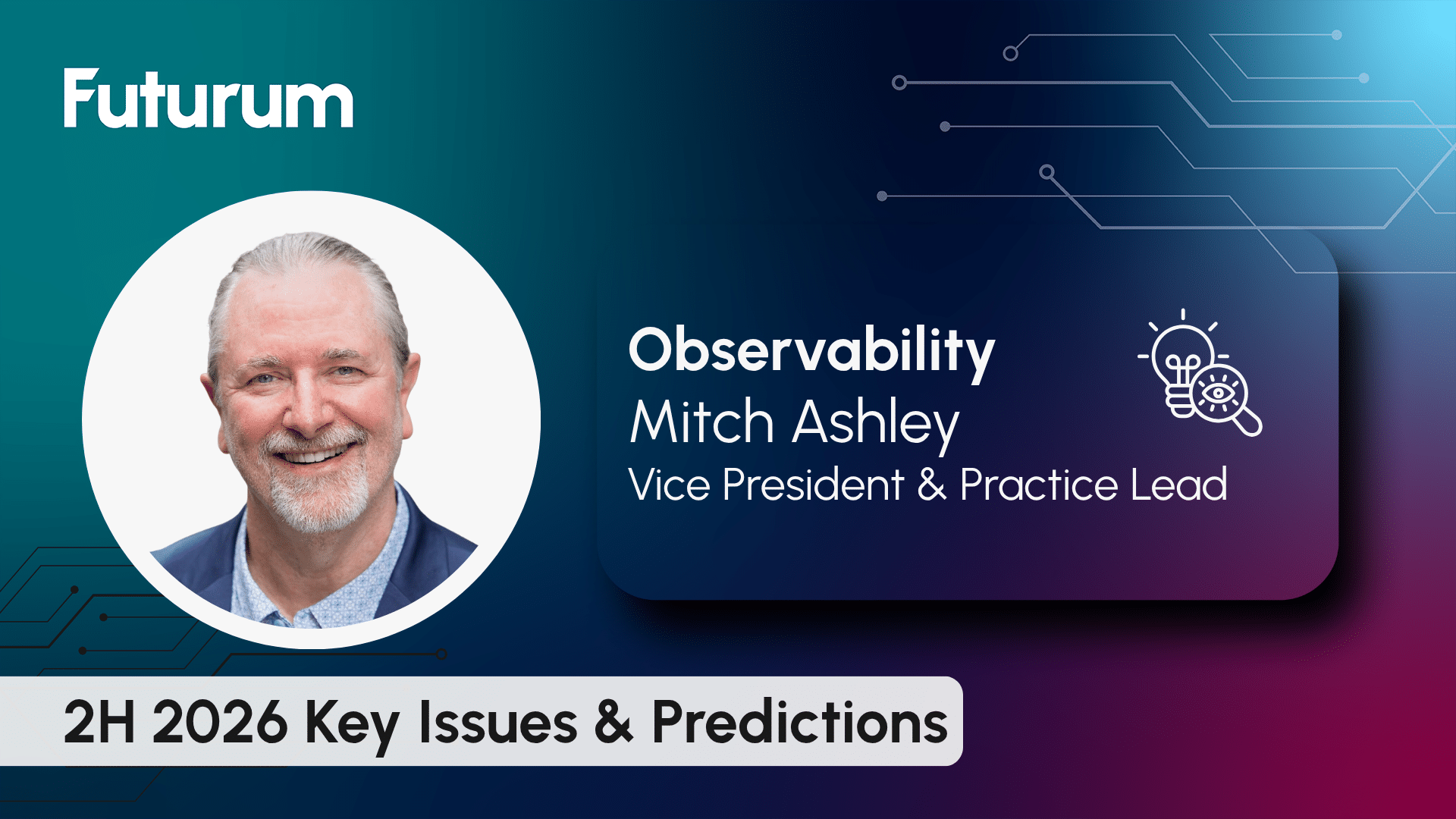
Observability:
Observability-Native Sets the Ceiling on Agent Autonomy

Prediction: By the end of 2026, the depth of an enterprise’s observability sets the hard ceiling on how much agent autonomy it will grant, and vendors whose platforms cannot capture the full decision cycle of intent, reasoning, constraints, and outcomes fall behind the market as buyers cap them at low-risk use cases. The demand signal is already in procurement: 37.4% of decision-makers rank AI observability a priority in platform selection, and 30.9% rank AI agent observability specifically, placing both ahead of distributed tracing at 23.7% ².

Watch on Vimeo

Digital Leadership, CIOs & Tech Buyers:
As AI Removes the Production Constraint, Value and Buying Authority Relocate, and Most Vendor Go-to-Market is Aimed at the Wrong Buyer

Prediction: The defining enterprise-technology shift in 2H 2026 is relocation. Adoption is no longer the story. As agentic systems move into operations, production stops being the scarce step. The binding constraint moves to governing, integrating, and verifying work that systems now generate at scale. Value collapses where production used to be the bottleneck and re-pools around the new one. Buying authority follows the value: up toward CIOs who tie technology to business outcomes, and out toward field CTOs and business-unit leaders who hold budget and execution. Vendors repositioning to sell to the CIO are often aiming at the wrong buyer. Vendors selling production acceleration alone are aiming at the wrong layer.

¹ Source: Futurum ETR AI Product Series, January 2026

² Source: 1H 2026 Software Lifecycle Engineering Decision-Maker Survey, Futurum Research, January 2026

Why This Is Trending

Software Lifecycle Engineering:

  • First Major AI Stack Land Grab Campaign Is Complete: The AI value question is what’s left to prove. Presence in a layer is now easy to buy and hard to justify, with only 36% of Microsoft 365 Copilot’s users saying value clears cost against 24% who say cost wins [ETR AI Product Series, May 2026, N=363]. The constraint has moved from whether organizations can run agents to whether they can prove the ones they run are worth the spend and safe to expand.
  • Interoperability Already Won the Architecture Argument: Open standards are how it gets enforced. A majority of enterprise builders, 56%, run multiple foundation model providers in production today, against just 15% on a single provider [Futurum ETR AI Product Series, March 2026]. MCP and agent-to-agent protocols are becoming the connective tissue of that multi-model reality, so the winning control plane is the one that speaks them natively and coordinates identity, policy, and execution oversight across models and tools it does not own.
  • Spend without proof is becoming a governance liability, not only a finance one: As agents move from single to continuous execution across build, test, and deploy loops, unaccounted agent cost and unaccountable agent action are the same failure surfaced two ways, and the control plane is where both get answered, or neither does.

Observability:

  • Enterprises Gate Agent By Observability and Control: This makes observability a structural constraint rather than a tooling preference. Low-risk work like code completion tolerates thin visibility, but autonomous deployment and production modification make invisible behavior unacceptable. Organizations will not delegate authority they cannot oversee, so the observability gap and the autonomy ceiling are the same line drawn twice.
  • Traditional Observability Cannot See What Matters Most: Alerts, metrics, logs, and traces were built for humans to reconstruct failures after the fact. Agents decide and act continuously at machine speed across planning, build, test, and deploy. Observability-native instead generates structured signals directly from agent workflows, capturing intent, reasoning, constraints, and outcomes as first-class telemetry rather than inferring them from infrastructure side effects.
  • Observability-Native Shifts Buying Decisions: Observability gaps are being reframed as governance failures. Boards, auditors, and regulators now ask how agents decide and act, and answering requires auditable decision trails that integrate with security, risk, and compliance workflows. Procurement follows the reframing, with RFPs beginning to require structured agent decision capture and excluding platforms that treat agent execution as opaque.

Digital Leadership, CIOs & Tech Buyers:

  • The Constraint Moved: When systems generate code, content, and analysis at scale, production is no longer where work backs up. Judgment, integration, governance, and verification are, and value re-pools there.
  • The Organization Reshapes Around it: Headcount, budget, and decision rights reorganize around the new scarce work, and authority moves with them, up to the outcome-tied CIO and out to the business units.
  • The Buyer and the Layer both Move: A motion built for a single CIO persona misses the field. A product built for production acceleration sells into the layer value is leaving.
  • The Bet is Expensive to get Wrong: Repointing go-to-market, packaging, and compensation at an executive buyer is a multi-quarter commitment, and vendors are making it on instinct.

Vendor Impact

Software Lifecycle Engineering:

  • Consumption-Based Pricing Shift: A coding-tool vendor stalls at the 20% developer-penetration ceiling and repositions from seat expansion to a value-attribution layer that ties agent output to delivery acceleration, converting deployed but dormant licenses into proven, expanding ones.
  • Governing Models You Don’t Own: A cloud or platform vendor wins a multi-model enterprise by governing agent identity and policy across rival models its customer already runs in production, becoming the trusted execution authority because it does not require single-vendor commitment.
  • Evidence Trail for Expanding Autonomy: An agent development or observability vendor extends its existing footprint into agent execution proof, generating the evidence trail a CIO needs to expand autonomy from low-risk to high-impact agents without an all-or-nothing bet.

Observability:

  • Autonomy Tiering by Visibility: An observability vendor packages decision-cycle capture as the control that lets a customer move a class of agents from supervised to autonomous, selling visibility as the unlock for higher-value automation rather than as monitoring.
  • The Compliance-Grade Decision Trail: A platform vendor wins a regulated buyer by generating intent-to-outcome audit records that satisfy security and risk teams, turning agent traceability into the procurement requirement competitors cannot meet.
  • Lifecycle Correlation as Differentiator: A vendor unifies build-time and run-time signals so a CIO can trace a production incident back to the agent decision that caused it, displacing point tools that observe one stage and explain none.

Digital Leadership, CIOs & Tech Buyers

  • Map the Buyer Before the Motion: Know where the buying authority actually sits by role and segment, and where it is moving, before spending a multi-quarter motion on a title that no longer decides alone.
  • Know Which Layer you Sell into: Production acceleration faces compression as value re-pools at governance, integration, verification, and orchestration. Locate the product in the collapsing layer or the re-pooling one, and reposition accordingly.
  • Test Readiness Before Repositioning: Selling up to an outcome-driven executive buyer is a different motion than selling to a technology team. The gap between intent and capability is where the shift fails or holds, and it is worth diagnosing before launch.

Podcast - Agents of Dev

Podcast - Still Cyber

Latest from Mitch Ashley

All work by Mitch Ashley