
Will Smartsheet’s Product Investments Address Work Management Challenges?

Keith Kirkpatrick, Research Director at The Futurum Group, examines Smartsheet’s enterprise enhancements in automation, scalability, and security and its positioning against Microsoft, Asana, and Monday.com.
Cite this

Analyst(s): Keith Kirkpatrick
Publication Date: April 16, 2025
Smartsheet reinforces its enterprise-grade positioning with a next-generation work management platform, showcasing 99.99% uptime and unlimited automation. As enterprises seek scalable, secure, and AI-driven work management solutions, Smartsheet’s enhancements place them in direct competition with Microsoft, Asana, and Monday.com.
What is Covered in this Article:
- Smartsheet is expanding its capacity and capabilities to support exponential growth by its customers.
- Hybrid deployment remains a priority, with 46% of enterprises preferring hybrid models for flexibility and scalability.
- Smartsheet processes large-scale enterprise data, managing 133 million tables and 16.8 billion synchronized rows per month.
- Automation remains key, with Smartsheet offering unlimited automation compared to a competitor’s 250,000/month limit.
- Security and compliance are strengthened, as Smartsheet meets ISO 27701, HIPAA, FedRAMP, SOC 2 & 3, and GDPR standards.
The News: Smartsheet has expanded its enterprise work management platform with key investments in scalability, automation, and enterprise security. The platform currently supports 20,000 items per table, 500,000 connections per table, 60,000 projects per portfolio, and 500,000 formulas, along with unlimited automation capabilities. Additionally, Smartsheet has strengthened its compliance certifications, including ISO 27701, HIPAA, FedRAMP, SOC 2 & 3, and GDPR, to meet enterprise security and governance requirements.
Will Smartsheet’s Product Investments Address Work Management Challenges?
Analyst Take: The enterprise work management software space is becoming increasingly competitive, with organizations seeking scalable, secure, and automation-driven solutions to support hybrid workforces, manage complex workflows, and integrate seamlessly with broader IT ecosystems. Smartsheet’s continued investment in its platform highlights a long-term commitment to enterprise-grade scalability, ensuring it can handle high-volume operations while maintaining strong governance and compliance controls.
Scaling Work Management for Enterprise Demands
As enterprise workloads expand, organizations require platforms capable of managing vast data volumes and complex automation workflows without performance bottlenecks. Smartsheet responds to these needs with planned scalability enhancements to support exponential growth. According to Futurum Research’s 2024 IT Enterprise Decision Makers Survey of nearly 800 respondents, roughly half (46.3%) of enterprises favored hybrid deployment models.
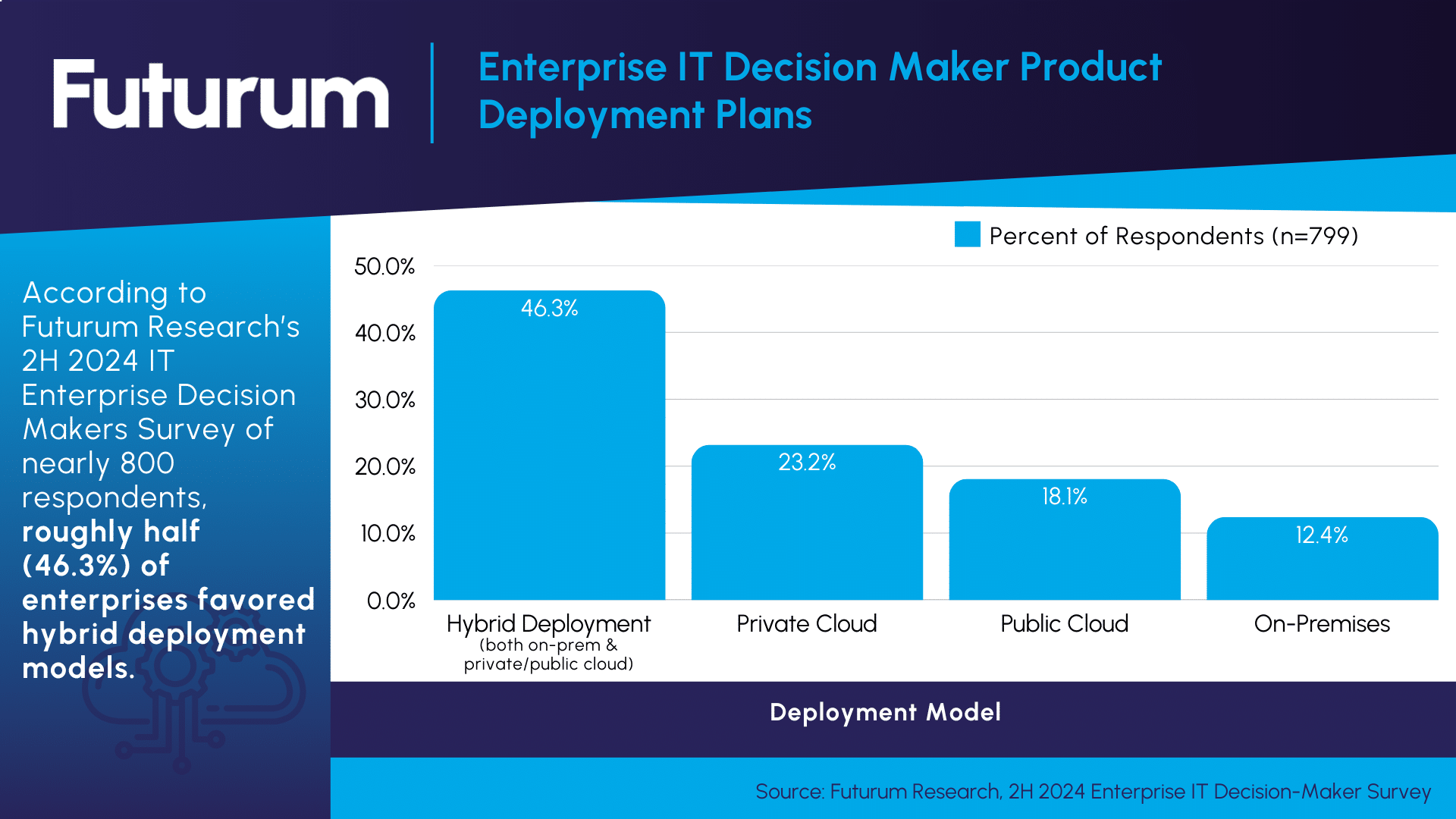
As such, the ability to operate seamlessly across on-premise and cloud environments is more critical than ever. These upgrades position Smartsheet as a strong contender for businesses that require high-performance work management solutions that align with evolving IT infrastructures.
Automation and AI Are Driving Work Management Innovation
According to the Futurum Intelligence IT Decision Maker survey, automation remains a top priority for enterprises, with 33% investing in AI-driven technologies to streamline workflows and enhance decision-making. Smartsheet differentiates itself by offering unlimited automation, whereas its closest competitor imposes a 250,000 automation limit per month. This flexibility enables businesses to scale workflow automation without restrictions, improving efficiency and reducing operational friction.
Smartsheet’s Bridge automation tool and low-code workflow automation capabilities aim to enable organizations to integrate systems, trigger real-time actions, and optimize processes with minimal IT intervention. Additionally, the company has boosted formula execution speeds by 10x in the new Table View, enabling real-time collaboration and faster processing of complex workflows. These advancements could help teams manage large-scale operations smoothly, reinforcing Smartsheet’s position as a key option for enterprises aiming to enhance productivity through automation.
Governance and Security Are Critical for IT Decision-Makers
Security, compliance, and governance are critical factors in enterprise software selection. Smartsheet meets stringent industry standards, including HIPAA, ISO 27701, FedRAMP, and SOC 2 & 3 compliance, positioning it as a reliable solution for highly regulated industries. Features like Event Reporting for compliance tracking and Dynamic View for controlled data access further enhance its appeal for IT-led deployments, ensuring organizations maintain visibility and security at scale.
According to the Futurum Intelligence IT Decision Maker survey, 40% of enterprises are shifting toward consumption-based pricing models. As a result, organizations are prioritizing solutions that offer both robust security and cost efficiency. Smartsheet’s ability to balance these factors strengthens its competitive positioning.
Competitive Outlook: Smartsheet’s Position in the Market
Smartsheet competes with Microsoft Project, Monday.com, and Asana in the enterprise work management space, differentiating itself with its scalability, governance-focused approach, and automation capabilities.
However, challenges remain for Smartsheet. Microsoft’s deep integration within enterprise IT ecosystems may make it challenging for Smartsheet to convince Microsoft customers to switch vendors, given the disruption that can often occur when moving to new software.
Meanwhile, Monday.com’s strong emphasis on user experience poses competitive hurdles for Smartsheet, particularly for customers seeking a solution designed to help new users quickly get up to speed. Similarly, Asana’s simple interface enables new users to start using the product immediately with little to no training, providing fast time to value.
That said, with 15.3 million users (including 85%+ of Fortune 500 customers), 150+ enterprise integrations and the ability to process 1.1 billion workflow executions per quarter, Smartsheet has demonstrated its enterprise-grade capabilities. Its ability to handle petabytes of content further solidifies its appeal for large organizations requiring high-performance, scalable solutions. To sustain its growth, Smartsheet’s continued investment in scalability, security, and automation will be crucial to driving continued growth in the evolving enterprise work management landscape.
What to Watch:
- How Smartsheet’s planned scalability upgrades impact enterprise adoption.
- How 46% of enterprises preferring hybrid deployment models shape demand for work management solutions.
- How unlimited automation vs. a competitor’s 250,000/month cap influences enterprise adoption and workflow scalability.
- How Smartsheet’s governance and compliance capabilities, including HIPAA, ISO 27701, and FedRAMP, position it in regulated industries.
- How Microsoft, Asana, and Monday.com’s competitive moves impact Smartsheet’s expansion in enterprise work management.
See the complete details on Smartsheet’s enterprise-scale capabilities on the Smartsheet Enterprise Solutions page.
Disclosure: The Futurum Group is a research and advisory firm that engages or has engaged in research, analysis, and advisory services with many technology companies, including those mentioned in this article. The author does not hold any equity positions with any company mentioned in this article.
Analysis and opinions expressed herein are specific to the analyst individually and data and other information that might have been provided for validation, not those of The Futurum Group as a whole.
Other insights from The Futurum Group:
Smartsheet’s Q3 FY2025 Earnings: Strong Financials and Strategic Milestones
Will Smartsheet’s New Enhancements Drive Efficiency and Better Work Management?
Blackstone and Vista Complete $8.4 Billion Smartsheet Takeover: What’s Next?
Subscribe to The Weekly
The week's market signals, one email, no filler. Unsubscribe any time.
More from Keith Kirkpatrick
Is Oracle Third-Party Support a the Lower-Risk Choice for Telcos?
Keith Kirkpatrick, VP, Research at Futurum, shares his insights on why a large European telco moved its business-critical Oracle estate to third-party support, and what it gained.
Genesys Forward-Deployed Engineering Aims to Speed Agentic CX
Keith Kirkpatrick, VP, Research at Futurum, shares his insights on Genesys forward-deployed engineering and whether embedded engineers can move agentic CX from pilot to production at scale.
Adobe Brings CX Enterprise Coworker into Third-Party AI Platforms
Keith Kirkpatrick, Vice President, Research, at Futurum, examines how Adobe's Enterprise Coworker integration into Anthropic, Google, OpenAI, and Microsoft platforms enables marketers to orchestrate customer experiences.